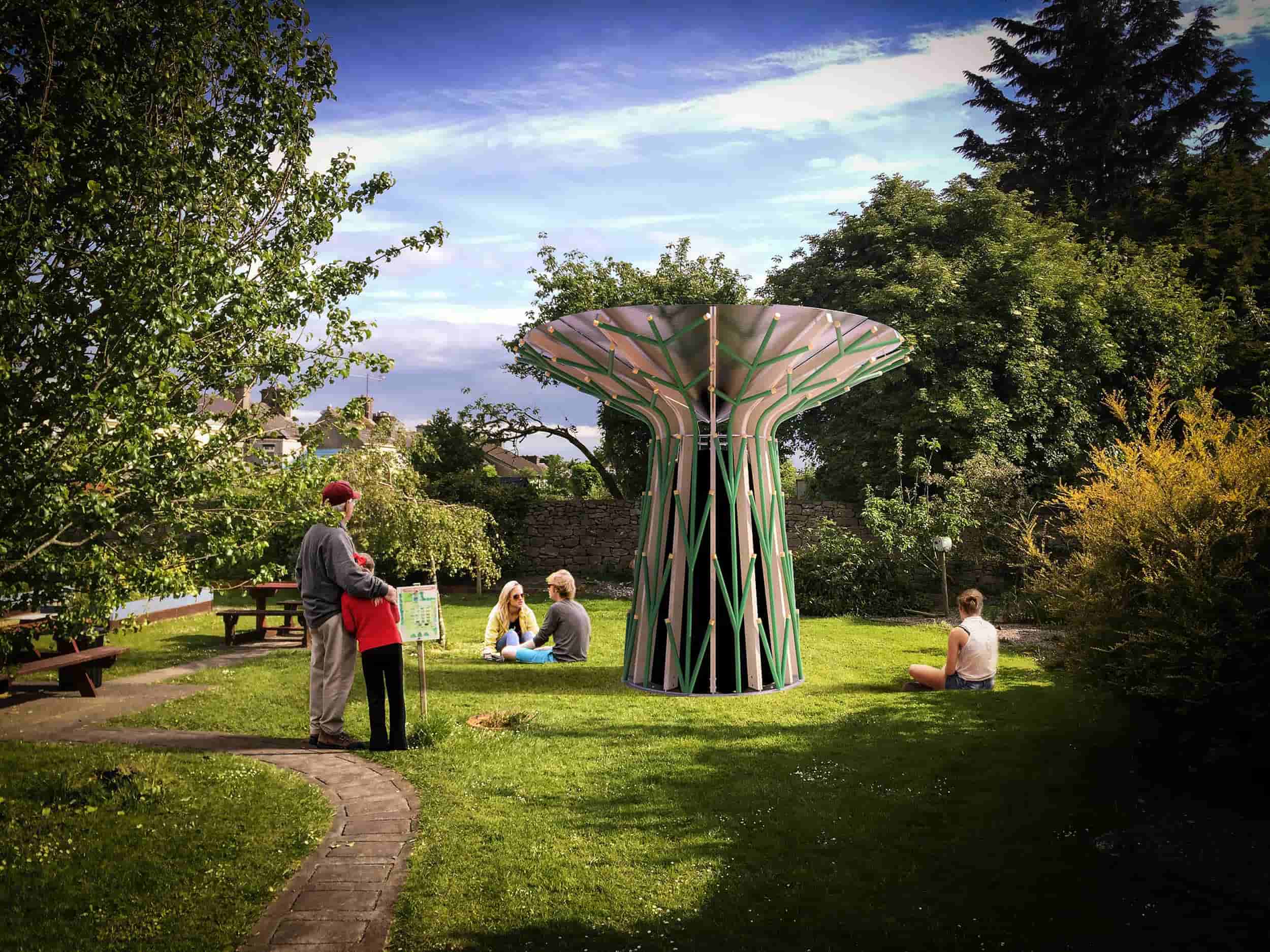
Ballinrobe’s community garden is a valuable but under-recognised green space that has shown vulnerability during extended dry periods. Reliance on the town’s mains supply and the absence of backup storage highlighted a need for greater resilience. With limited visibility, the garden also needed a focal point to draw more people into the space. Climatree was conceived to address both issues.
Its aims are to provide an independent rainwater system, create an engaging focal point, inspire climate curiosity through interactivity and environmental data, demonstrate sustainable local fabrication, and present climate action as something beautiful and participatory.
Inspired by ecological thinking around “Gaia 2.0”, the idea that humans can add a layer of self-awareness to Earth’s systems, Climatree acts as a sculptural “tree” that senses, collects, and shares environmental data while inviting people to interact with it.
The tower is built from locally sourced materials: marine plywood, UV-resistant tubing, galvanised steel petals, a recycled HDPE tank, and biochar-infused low-carbon concrete. Solar-powered electronics, infrared and capacitive sensors, and 3D-printed LED inserts introduce interactivity while conserving energy when the garden is empty.
Challenges included unifying infrastructure with public art, integrating outdoor electronics, and minimising carbon footprint. These were resolved through iterative design.
Climatree provides over 1,000 litres of harvested water, increases the garden’s visibility, and publishes live environmental data for community use. Its embodied carbon footprint (~2 tonnes) has been offset by planting 70 native Irish trees. As both functional system and catalyst for climate engagement, it strengthens the garden’s resilience and its role within the community.